
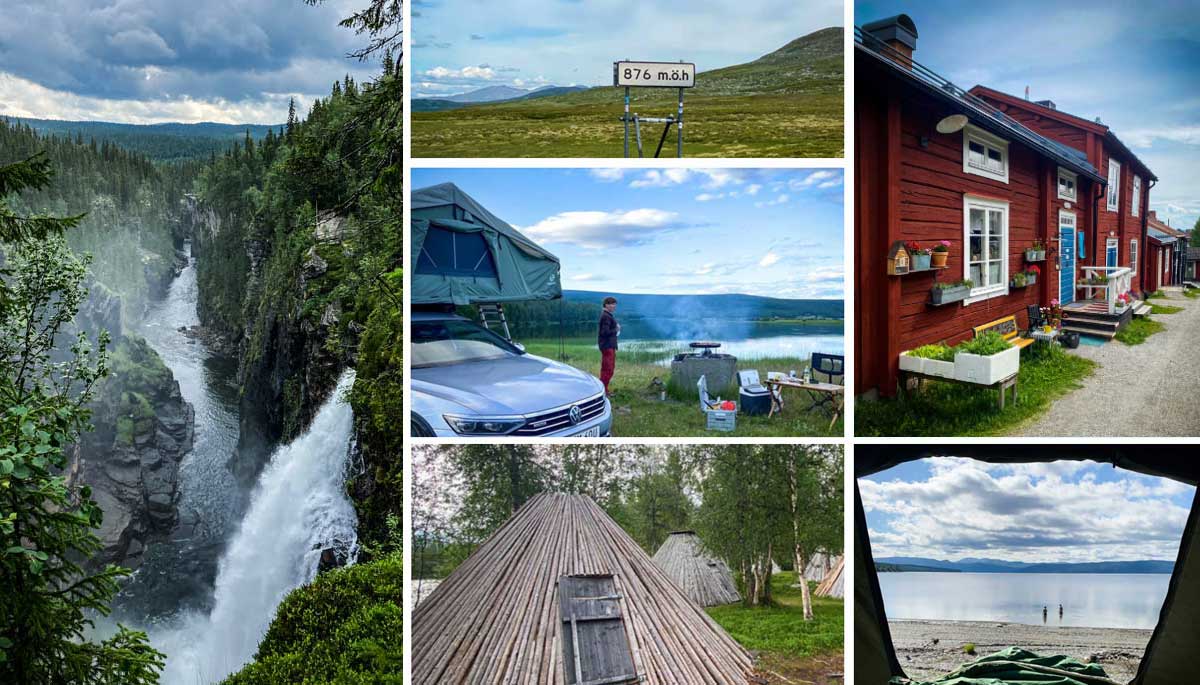
For those who want to combine beautiful mountain environments with a road trip, a journey along the 500 km long Wilderness Road in northern Jämtland and Southern Lapland is perfect! The Wilderness Road is ideal for anyone traveling by car, motorhome, or camper van – and not least roof tents, which we used on our trip.
In this guide, we list practical information and tips for those who are considering or planning to travel the Wilderness Road. Further down in the post, you will also find our 11 gems along the Wilderness Road you simply must not miss.
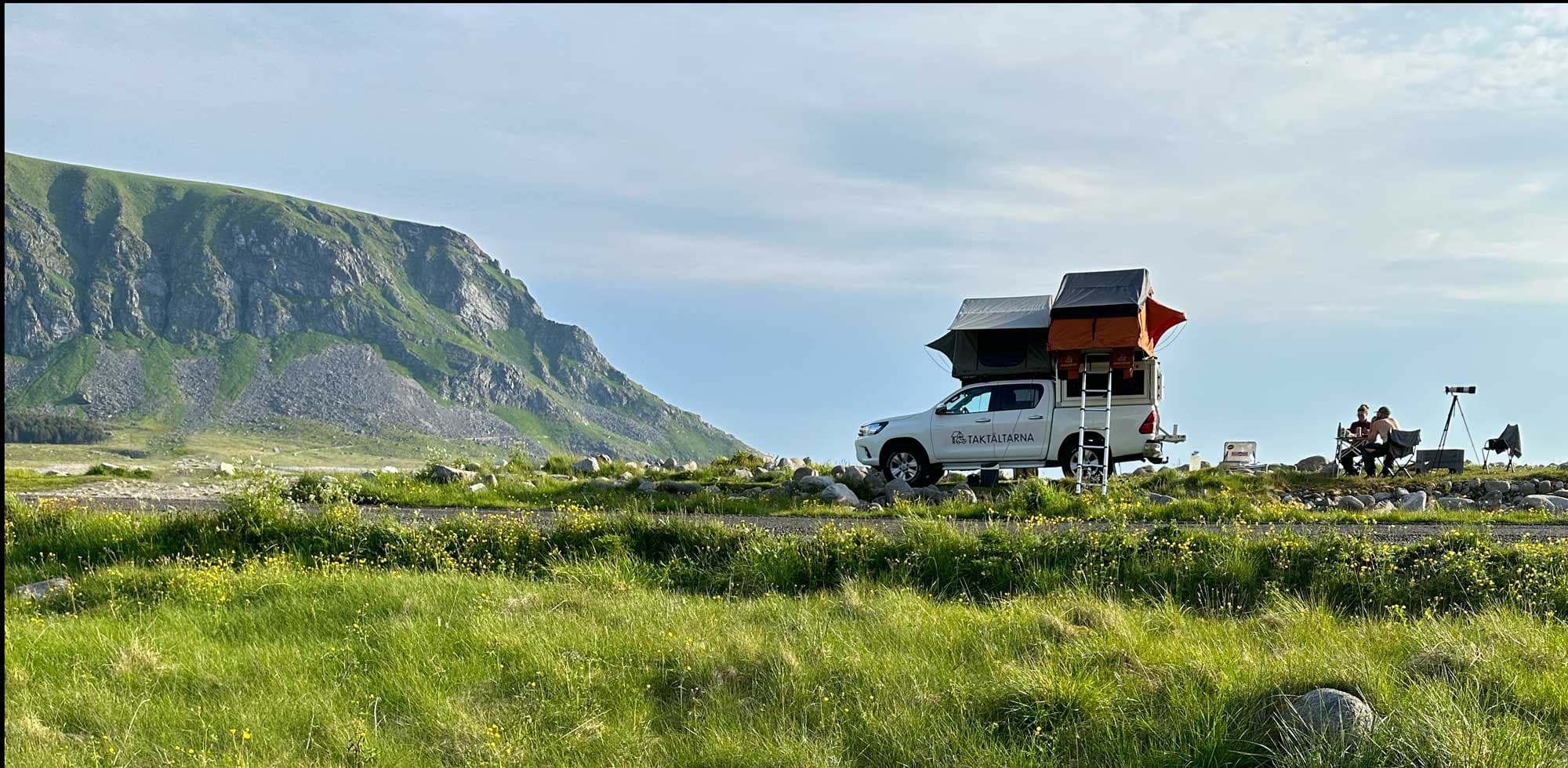
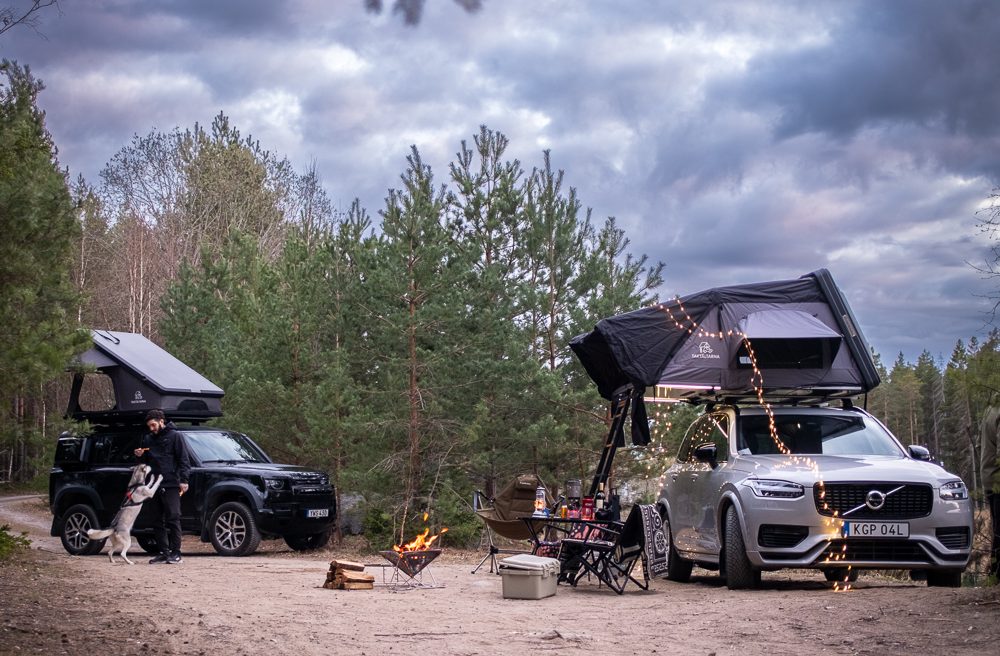
We made our trip with the Åreskutan roof tent.
Sweden's highest paved road
The beautiful Wilderness Road is Sweden's highest paved road. The most famous stretch goes over the Stekenjokk plateau between Lapland and Jämtland. Here you drive on a road up on the bare mountain, surrounded by mountain peaks and beautiful expanses. The easy accessibility means you can get the experience of mountain hiking without even leaving the car!
The stretch over Stekenjokk itself is about 20 kilometers and only a small part of the Wilderness Road, which is a total of 500 kilometers, and there is much more to discover.

The Wilderness Road is paved all the way around, while some detours – such as to Hällingsåfallet or Marsliden – are on gravel roads.
Accommodation along the Wilderness Road
Along the Wilderness Road, there are many accommodation options – both campsites and hotels. But many also choose to bring their own accommodation in the form of motorhomes, caravans, tents, or in our case – roof tents.
If you want to sleep along the most spectacular part around the Stekenjokk plateau, there are no other options than your own accommodation. You can stay 24 hours in a motorhome, caravan, or tent at designated places in Stekenjokk. There is a huge parking bay that, when we passed, looked more like a campsite with motorhomes and more motorhomes in a row.
Which direction should you drive the Wilderness Road?
The Wilderness Road starts in the south at E45 in Strömsund and in the north in Vilhelmina. Which way you choose to go is not really important, but when people ask for tips in Facebook groups, a majority usually recommend going clockwise.
Then you turn off at Strömsund towards Gäddede. Many who have driven the Wilderness Road one way often choose to drive it again later but in the opposite direction because the views then become different.
When is the best time to go?
The choice of when to drive the Wilderness Road is mainly determined by the accessibility of the stretch over Stekenjokk. Due to the large amounts of snow there, the road is usually open from early June to mid-October, typically June 6 – October 15.
When does the Wilderness Road open and close?
The road over the Stekenjokk plateau usually opens on June 6, Sweden's National Day.
The Wilderness Road, or more precisely the stretch over Stekenjokk, closes on October 15.
You may have seen spectacular pictures where you drive on a road surrounded by several meters high snow walls on the sides – these are usually from the time when the road opens (if it has been a snowy winter, it is not always like that).
If you choose to drive the Stekenjokk plateau when the road opens, expect there may be significant queues; otherwise, this is usually not a problem.
Prohibition to leave the car
At the beginning of summer, there may be a ban on stopping and leaving your vehicle on certain parts of the road over the Stekenjokk plateau, due to reindeer herding and some areas being bird protection zones.
To complicate matters a bit, the border between Jämtland and Västerbotten counties runs over the plateau, and to check what applies, you need to look for information from the respective county administrative boards; here is Jämtland County Administrative Board and here is Västerbotten County Administrative Board.
There are also many Facebook groups about the Wilderness Road where you can seek information or answers, for example We who drive the Wilderness Road.
A general tip is also to check with the tourist offices in Strömsund and Vilhelmina, both for current practical information or excursion destinations.
If you want to avoid having to deal with restrictions, you should choose to drive the Wilderness Road from mid-July; historically, restrictions on where you can stop and hike are lifted then. If you want to experience massive snow walls, you should go as soon as the road opens in June.
We drove in mid-July; personally, I would like to do it again in September for the vibrant autumn colors.
How many days are needed to drive the Wilderness Road?
How many days you should spend on your trip along the Wilderness Road depends, of course, on what you want to do along the way. If the Stekenjokk plateau is your main focus, you can of course drive the whole thing in 1-2 days.
But there is so much to see and do that I would recommend you take at least four nights, maybe a whole week if you really want to maximize!
Think through before you go what you want to get out of your trip along the Wilderness Road. If you want to fit in hikes, flea markets, visits to towns and Sami church villages, you will need more days.
My recommendation (learned from experience) is to take an extra day; it's never fun to have to skip things and sights due to lack of time.
Map of the Wilderness Road
Here you can see a map of the Wilderness Road where various sights and activities are marked. Further down in this blog post, I give tips on my favorite places along the Wilderness Road.

I (Elisabeth, who runs Taktältarna) and my friend Emma drove the Wilderness Road with a roof tent in the summer of 2021, but we did it with a little twist. Since we live in Åre, we chose to take the route through Norway up to Gäddede to drive on some new roads (between Strömsund and Gäddede there is not much to see, in our opinion).
We thus joined the actual Wilderness Road at Gäddede where we first chose to drive back a little towards Strömsund to experience Hällingsåfallet and then turned around and drove back north.
11 gems you must not miss along the Wilderness Road
We had 5 days to drive the Wilderness Road. We planned which stops to make day by day; it became a fun activity while we relaxed by the fire in the evening.
1. Hällingsåfallet

The 42-meter-high Hällingsåfallet is a truly powerful experience! You can drive all the way to the waterfall by car, but better to stop at the parking lot about 1.5 kilometers before and hike 2 kilometers to the waterfall. The trail goes along the Hällingsån river and up to Sweden's largest canyon. Right at the start of the canyon, there is an incredibly beautiful place to swim. 
The hike is easy and the views (when you reach the canyon) are magnificent; I would almost say the canyon is as big an experience as the waterfall itself, and if you go directly to the waterfall parking lot, you won't experience it the same way.
2. Stora Blåsjön

Stora Blåsjön is surrounded by mountains, and at the lake's northwest corner, you will find the village of the same name and also Camp Stora Blåsjön where there are both motorhome pitches and tent sites. The unique thing is that they have arranged so you can park right on the beach – a must-stay place along the Wilderness Road if you have a roof tent or campervan! With a motorhome, it is trickier to get up and down to the beach.
You can wake up and run straight into the lake for a morning swim (which we of course did). Another great thing is that you can order rolls and buns for breakfast delivered directly to you in the morning. So good with freshly baked!
We would have loved to eat at Restaurant Fjällripan run by (former?) Angry Chef Alexander Nilsson, but unfortunately, it was fully booked. So a tip is to book well in advance for a visit.
3. Brakkåfallet

Just before Stora Blåsjön (if you come from Gäddede) lies Brakkåfallet; it is only a few meters walk to get there. Tip! Take the trail that goes down to the bottom of the waterfall, and why not take a swim?
4. Ankerede church village

Ankarede Church Village is a Sami church village, the only one in Jämtland still in use. The church village was also used by the rest of the local population. It is classified as a national interest for cultural environment preservation and weddings, baptisms, and funerals are still held here today. On site, there is Ankarede chapel, about 30 traditional huts, a small museum, and a cozy café. There are also many hiking trails starting here, but none we tried ourselves.
Ankarede has long been a gathering and meeting place for Sami in northern Jämtland where reindeer and reindeer herders from Frostviken previously passed on their way between summer and winter pastures.
5. Bjurälven Nature Reserve

Bjurälven Nature Reserve has a very unique environment and is highly recommended for those interested in nature and hiking. An underground river has contributed to creating the karst landscape, a term for the special landscape formed on limestone with completely or partially underground waterways.
Bjurälven's water combined with carbon dioxide in the air has dissolved the limestone, creating caves, underground channels, and other unique rock formations. Some highlights are Dolinsjön, the Blind Valley, and the Colosseum. The hike around is a total of 12 kilometers. We prepared lunch at the parking lot and then brought treats for coffee breaks along the way. The spectacular part starts after 3 kilometers when you reach Lillälven Rest Cabin, where there is a fireplace, toilet, and trash bin.
The hike is hilly but well maintained with many sturdy stairs. Don't miss swimming in the waterfall below the rest cabin (we did that when we returned from the hike, so nice after sweating up and down the stairs!). Read more about Bjurälven Nature Reserve here.

6. Stekenjokk
Amazing environments greet you up on the Stekenjokk plateau where you can mountain hike by car! For a while, we almost thought we were in Norway, which is not a bad compliment. A unique experience for Sweden. There are plenty of parking bays to stop at for overnight stays or hiking. We followed the stream here.

Below Stekenjokk lies the small village Klimpfjäll, where we found a really nice roof tent site surrounded by water, a small stream, and a barbecue area. 
7. Trappstegsforsen
Trappstegsforsen is a must-stop for everyone driving the Wilderness Road. It is located right next to the road, 5 kilometers south of Saxnäs and can even be seen from the road.

Trappstegsforsen is a waterfall shaped like a staircase where the water from Kultsjön lake cascades down. Right next to it is a grill with good burgers.
8. The swimming spot near Marsliden
A few kilometers before the village Marsliden lies a fantastic swimming spot. It is a sandy beach surrounded by majestic mountains. You cannot camp right by the beach but can do so at a parking bay along the small road. We went there, took a swim, and continued. In the village Marsliden, next to a small shop, there is also a cute little collector's museum with all kinds of things, including a pair of Ingemar Stenmark's skis.
9. Bergmans Fisk & Vilt
Our only restaurant meal during the trip (otherwise we cooked on a griddle and Trangia stove) was at Bergmans Fisk & Vilt located just north of Vilhelmina. Really tasty pizzas and a wonderful delicatessen with lots of different smoked products.
10. Vilhelmina church village and museum

We stopped in Vilhelmina and walked around the old and beautiful wooden houses in Vilhelmina church village. Today, the old buildings house a hostel (so you can stay overnight if you want!) and some private residences. Right next to it is Vilhelmina museum, a small but very worthwhile museum about the town and region's history, Sami history, and more.
11. Flea market tour between Vilhelmina and Strömsund

After leaving Vilhelmina, we stopped at every flea market sign we saw along the E45 down towards Strömsund. There were quite a few stops and many good flea market finds! A fun activity if you are not in a hurry.
Rent a roof tent or motorhome for your trip along the Wilderness Road
As I have already mentioned, a roof tent trip is a great way to experience the Wilderness Road. Here you find our roof tents, developed for the Nordic climate. If you don't have your own, we at Taktältarna offer roof tent rentals.
If you prefer to experience the Wilderness Road with a motorhome, you can rent one on the site camptoo.se where private individuals rent out to other private individuals.
For the next time we drive the Wilderness Road
I would also very much like to visit Korallgrottan but there were no guided tours when we were nearby. Korallgrottan is Sweden's longest cave consisting of a maze of passages, large halls, and small crawl spaces.
I would really also, as I mentioned earlier, like to see the Wilderness Road in autumn colors, so that will be next time!